Resource Library
Planning guides and operating notes for shower trailer rentals across Utah.
- Running Shower Trailers Through a Utah Winter
- Crew Showers for Utah Construction, Highway, Mining and Energy Work
- Shower Trailers for Utah Events, Film Production and Group Camps
- The Utah Site Preparation and Planning Guide
Running Shower Trailers Through a Utah Winter
Freeze protection, power, drainage and what a Utah site actually needs to keep a shower trailer working below freezing.
Utah winters are not gentle on plumbing. We have pulled shower trailers into job sites in Vernal at ten below and set them up at a ski event above Park City while it was still snowing sideways. A shower trailer that works fine in October will turn into an expensive block of ice in January if nobody thought about the cold ahead of time. This is how we keep units running from the first hard freeze through spring runoff, and what we need from a site to make that happen.
What actually freezes first
People assume the water tank is the weak point. It usually is not. A large body of water holds heat for a long time, and a full tank sitting in an insulated compartment can ride out a cold night without much help. The parts that freeze are the small ones. Supply lines running through an exterior wall, the short stretch of hose between a spigot and the trailer inlet, the drain hose lying on frozen ground, the P traps under the sinks, the water heater inlet, and the pump head. Those hold a small amount of water with a lot of surface area, which is exactly the recipe for ice.
That matters because of how the failures show up. A frozen supply line usually just means no water until things thaw. A frozen drain line means water backs up into a stall while somebody is standing in it. A split line inside a wall means water in places you cannot see until the damage is done. So our winter work is mostly about the small plumbing, not the big tanks.
How a winter ready trailer is built
Cold weather units are not the same as the ones we roll out for a summer wedding in Provo Canyon. The differences are structural. Plumbing is routed through heated interior spaces wherever possible instead of chased along an outside wall. Underbelly compartments are enclosed and insulated so wind cannot strip heat off the lines. Tanks and exposed runs carry heat, and the interior itself is climate controlled so the cabin stays warm between users instead of dropping to ambient overnight.
The interior heat is doing more work than most people realize. A trailer that stays warm inside keeps every line that passes through the cabin warm too. That is why we tell crews not to prop the door open in winter. One propped door on a windy night in Price can undo everything else we did.
What we do before a unit leaves the yard
Our winter prep is a checklist, and we run it on every unit from roughly late October through April depending on where the job is.
- Every line gets inspected and pressure checked cold, not warm, because a hairline crack will seal itself at room temperature and open up at twenty degrees.
- Heat sources on tanks, lines and the pump bay are tested individually, not just switched on as a group.
- Insulation on the underbelly gets checked for road damage. Gravel roads in the Uinta Basin and washboard stretches in the San Rafael country are hard on anything hanging below the frame.
- We carry insulated and heated supply hose rather than hoping a standard garden hose survives the week.
- Water heaters are cycled to confirm recovery rate, because a heater that is marginal in July will not keep up with forty degree incoming water in January.
- Antifreeze rated for potable systems goes in any section that will sit idle, and we document exactly which sections were treated so nobody flushes a line and assumes it is protected.
What the site needs when it is below freezing
Here is the honest part. We can winterize a trailer thoroughly and it will still fail if the site cannot hold up its end. Three things matter more than everything else combined.
Uninterrupted power. Freeze protection is electric. Tank heat, line heat, the cabin furnace and the water heater all draw power, and they draw it around the clock, not just while people are showering. If the generator runs out of fuel at two in the morning, the trailer is unprotected for the coldest hours of the night. On sites without utility power we plan fuel service on a schedule that assumes nobody is awake to catch a problem. If the site has shore power, we want a dedicated circuit that nobody else is going to trip by plugging in a heater in the job trailer next door.
A drain path that will not freeze. Gray water leaving the trailer has to go somewhere that stays flowing. A drain hose lying flat across frozen dirt will ice up from the far end backward. We set drain runs with continuous fall, keep them short, insulate or heat them, and where the arrangement allows we drain into an onboard waste tank rather than running a long line at all. In deep cold, a self contained setup with pumped service is often more reliable than a hookup.
Reasonable access in snow. A trailer that cannot be reached cannot be serviced. Plowing matters, and so does where the snow gets piled. We have shown up to units buried behind a berm that a contractor pushed up over the weekend. Keep a path to the service side and a place for the service truck to sit.
Elevation changes the math
Utah is not one climate. A January job in St. George is a mild job. The same week in Logan or Heber is a different animal, and a site above eight thousand feet in the Wasatch is different again. Temperature swing matters as much as the low. Along the Wasatch Front you can see a forty degree spread in a single day, which means lines thaw, drip, refreeze and split. High desert sites near Vernal or Price can be sunny and pleasant at noon and brutally cold by nine at night, and the wind out there pulls heat off equipment faster than the thermometer suggests.
How we service a unit in the cold
Servicing in winter is slower and we schedule it that way. Pump trucks have their own freeze issues, hoses stiffen, and connections that snap together easily in August fight you in February. We service earlier in the day when we can, because working in daylight and slightly warmer air reduces the chance of leaving water sitting in a fitting that freezes overnight. We also blow out and drain every external connection after service rather than leaving residual water in a hose.
What we ask customers to do
The site crew does not need to be plumbers. They need to do four small things and tell us when something looks wrong.
- Keep the door closed. A latched door in winter is free insurance.
- Leave the heat on. Turning the cabin heat down to save fuel overnight is the single most common cause of a frozen line we see.
- Watch the fuel. If the unit runs on generator power, treat fuel level as a freeze protection item, not just a convenience item.
- Call early. Slow drainage, a drop in hot water, or water pooling under the trailer are all early warnings. Those are cheap to fix on day one and expensive on day three.
The short version
Cold weather shower trailer service in Utah comes down to heat, power and drainage, maintained continuously rather than reactively. We build the winter protection into the unit, we prep it before it ships, and we service it on a schedule that assumes the weather will be worse than forecast. If you are planning a winter project anywhere from Logan down to Cedar City, tell us the elevation, the power situation and how the site handles snow removal, and we will tell you exactly what setup will hold up.
Crew Showers for Utah Construction, Highway, Mining and Energy Work
How we plan shower trailer placements for Utah work crews, including remote Uinta Basin sites with no water, power or sewer.
Most of our long term work in Utah is crew work. Pipeline and well pad crews in the Uinta Basin, highway contractors on state routes and interstate rebuilds, mine operations, transmission line crews, and disaster and utility restoration teams. These jobs have something in common. The work is dirty, the sites are often far from anything, and the crew has to be functional again the next morning. A shower at the end of a shift is not a luxury on that kind of job, it is part of keeping people healthy and keeping them from quitting.
Why crews end up needing showers on site
The usual driver is distance. A crew working a well pad an hour outside Roosevelt is not driving back to Vernal for a motel every night and then driving back out at four in the morning. Man camps and remote lodging fill up fast during active seasons, and when they are full the nearest real bed can be a long way off. Putting showers at or near the work site cuts hours of windshield time out of every day.
The second driver is contamination control. Crews working around drilling fluids, silica dust, cement, asphalt, soil remediation or mine dust should not be carrying that home in their clothes and on their skin. A shower unit near the exit point of the work area gives you a clean break between the job and everything else. On some jobs this is a written requirement. On many others it should be.
The third driver is retention, and it is the one nobody puts in the bid. Crews compare jobs. A site with hot water and a clean private stall keeps people on the crew longer than a site without. We have had superintendents tell us plainly that the shower trailer was the cheapest morale spend on the project.
Uinta Basin logistics
The Basin is its own world and we plan differently for it. Sites out past Roosevelt, Duchesne, Myton and Bonanza can be a long way down county and lease roads, and those roads change character with the weather. Dry in August, greasy after a thunderstorm, and snow covered with drifts from November on. That affects three decisions.
First, unit size and trailer configuration. A large unit is fantastic until it cannot get down the road. We would rather place two smaller trailers that can actually reach the pad than one big one that strands the service truck. Second, service interval. If a site is two hours from our service base, we plan capacity so the unit can go longer between visits and we build in margin for a road that closes. Third, self contained operation. Most Basin sites have no water hookup and no utility power. We plan those as fully self contained placements with scheduled fresh water delivery and waste pumping, plus fuel service for the generator.
Doing the stall math for a crew
Crews are easier to plan for than public events because the schedule is predictable. You know the headcount, you know when the shift ends, and you know how long people have. The variables are the size of the shift change window and whether the crew rotates.
- A single crew coming off shift all at once needs enough stalls to clear everyone in a reasonable window, or people wait in line in a gravel lot in the dark.
- Staggered crews or a rotation across two shifts can run on fewer stalls because demand is spread out.
- Mixed crews need separate designated units or a schedule, and on larger jobs we usually place separate trailers rather than trying to manage a schedule that nobody follows after week two.
Hot water recovery is the number that actually limits throughput, not stall count. A unit with plenty of stalls and a heater that cannot keep up will run cold on the tenth person. We size the heating capacity to the shift change, not to the headcount on paper.
Water in, waste out, with no hookups
A self contained placement is a supply chain. Fresh water goes in, gray water comes out, and fuel goes in for the generator. Get that rhythm right and the unit is invisible to the crew. Get it wrong and the superintendent is calling us instead of running his job.
We set a service schedule based on real usage rather than a guess, and we adjust it after the first week once we can see actual draw. On busy crew sites that often means multiple service visits per week. Where a site has a water source we can draw from legally and safely, we use it and cut the delivery cost. Where there is a permitted disposal option nearby, we use that instead of hauling gray water back across the state, which shortens the service loop and makes the schedule more reliable.
Waste disposal gets handled properly and documented. Gray water from a shower unit is not something to dump on the ground behind a berm, and on federal, state trust or tribal land the rules are specific. We handle disposal through approved facilities and keep the records, because the last thing a contractor needs is a violation attached to a shower trailer.
Highway and utility work along the Wasatch Front
Front work is a different problem. Sites near Salt Lake City, Ogden, Layton, Provo and Lehi usually have utilities available and are close to our service base, so logistics are easy. The hard part is space and permitting. An interstate rebuild has a narrow work corridor, and the staging yard is often blocks away from where the crew actually works. We plan placement around laydown yards and around the traffic control plan, and we work around night work schedules, since a lot of Front highway work happens between ten at night and five in the morning. That flips the service window. We are not going to run a pump truck next to a trailer at three in the morning while a crew is trying to use it.
Mining and industrial sites
Mine sites in Utah, from the copper and coal operations to the smaller aggregate and industrial mineral operations, tend to have the most structure around hygiene. Clean side and dirty side separation is often a formal requirement, which means placement is not negotiable and we work to the site plan rather than suggesting our own. Those sites usually have power available, which simplifies everything, and they usually have a safety orientation requirement for our service drivers. We plan for that so a driver is not turned away at the gate on the first service day.
Keeping a crew unit actually clean
A crew shower unit gets used harder than anything else we rent. Boots, mud, grit and heavy traffic. The ones that stay nice have three things going for them. There is a boot and gear staging area outside so the worst of the dirt never gets inside. Service visits include a real cleaning, not just a pump and go. And somebody on the crew owns the unit, meaning one person notices when supplies run low or something breaks and tells us. On long placements we set that expectation in the first week and it makes an enormous difference over a six month job.
Planning the term
Crew work is usually measured in months rather than days, and that changes what makes sense. Long placements justify a more capable unit, a better generator setup, winter protection, and a service schedule tuned to the site. They also let us get ahead of seasonal changes. If a job starts in September in Vernal and runs through March, we are building the winter plan in September, not in the middle of the first cold snap. Tell us the start date, the expected end, the headcount and the road in, and we will build the placement around the way the job actually runs.
Shower Trailers for Utah Events, Film Production and Group Camps
Guest counts, placement, servicing and the seasonal realities of festivals, races, productions and large camps across Utah.
Events are the opposite of crew work. The headcount is bigger, the schedule is tighter, and everybody sees the unit, including people who have never thought about a shower trailer in their life. Utah gives us a lot of variety here. Music and arts festivals, endurance races along the Wasatch, film production in the red rock country, youth camps, large church and scout gatherings, county fairs, and the steady rhythm of ski season events around Park City. What follows is how we plan those.
Start with who actually showers
The first mistake in event planning is using attendance as the number. Attendance is almost never the shower population. What matters is how many people sleep on site and how many of them will realistically use a shower during the run.
A three day festival with a large day crowd and a small camping area has a shower population of the campers plus staff, not the gate count. A youth camp where everyone stays the whole week has a shower population equal to the roster. A film production has a small, demanding population with unpredictable timing. Endurance events have a huge spike right after the finish and almost nothing before it. Each of those shapes the plan differently.
The second number is the window. A camp where a hundred kids all need to be ready for breakfast at seven is a much harder problem than a festival where people drift in and out from morning to midnight. We size stalls to the peak window, and we size water heating to the peak window too, because that is what fails first.
Festivals and multi day outdoor events
Festival planning in Utah has a seasonal shape. Summer events in the southern half of the state mean heat, and heat changes behavior. In St. George or out near Moab in the warm months, people shower more than once a day and they use more water per shower, so the plan that worked for a September event in Logan will come up short in July down south.
A few things we have learned running festival placements:
- Put the units where people already walk. A shower trailer tucked in a back corner for aesthetic reasons creates a line at the one entrance and a dead zone everywhere else.
- Lighting matters more than anything else for perception. A well lit path to a clean, well lit unit gets used and gets good comments. A dark path does not, regardless of how nice the trailer is.
- Separate staff and artist showers from the general population if the budget allows. Staff and performers work odd hours and having a dedicated unit keeps them out of the peak crush.
Film production in southern Utah
Production work is its own category. Southern Utah draws a lot of shooting, and crews base out of Moab, Kanab, Cedar City, and the corridor around the national parks. The sites are frequently remote with no utilities at all, and production runs on a schedule that has nothing to do with normal hours.
What production needs from us is mostly reliability and discretion. A unit that cannot deliver hot water at four in the morning before a sunrise call is a failed unit. So is one that we have to service loudly in the middle of a take. We build the service schedule around the shooting schedule and we get the call sheet timing from the production coordinator rather than assuming.
Talent and crew expectations differ, and productions usually place separate units for that reason. Privacy, cleanliness, climate control and a real vanity space matter here more than raw stall count. A production with a modest headcount may want a nicer unit than a festival with ten times the population.
Large group camps, church and scout gatherings
Utah has a lot of large youth and church camps, and they are among the most predictable events we serve. Everyone is on site the whole time, the schedule is structured, and the shower window is usually tight and repeated daily. That predictability is good news because we can size accurately.
Things we plan for specifically with youth and group camps:
- Separate units by group, clearly marked, placed apart from each other rather than side by side. It makes supervision simpler.
- Plan the window. If a camp has two hundred people and a ninety minute morning window, that is a throughput problem, and the answer is usually more stalls plus a posted rotation by cabin or group.
- Locate near the sleeping areas, not near the dining hall. People walk to showers in whatever they slept in.
- Supply resupply. Group camps burn through paper and soap faster than any other event type, and running out on day three sours the whole week.
- Have a plan for wet ground. A hundred people walking the same path twice a day will destroy grass. Matting or gravel staging on the approach keeps it usable.
Mountain camps also hit the elevation and temperature issue. A camp at eight or nine thousand feet in July can drop into the forties overnight, and kids showering at six in the morning in a cold trailer is a complaint waiting to happen. Climate controlled interiors matter as much at a summer camp in the high country as they do in winter.
Races, rides and outdoor endurance events
Endurance events have the sharpest demand curve of anything we serve. Almost nothing for hours, then an enormous spike as finishers come in, then nothing again. Sizing to the average is useless. We size to the spike or we accept a line, and we tell organizers that honestly up front so they can choose.
Placement basics for any event
Placement decisions are usually made by someone looking at a site map, and the map lies. We would rather walk the site. The things we are looking for are a level spot, a surface that will hold up under a heavy trailer for the length of the event, an approach the tow vehicle can actually use, and a service path we can reach on the last day without crossing the middle of the event. That last one gets missed constantly. A trailer placed inside a fenced festival footprint with no gate wide enough to get it back out becomes a problem at load out.
Servicing across a multi day run
For anything longer than a single day, servicing is scheduled rather than reactive. We plan fresh water, waste pumping, cleaning and restocking at times that do not collide with peak use. For a festival that usually means very early morning. For a camp it means mid morning after the breakfast rush. For production it means whatever the call sheet allows.
On larger or higher profile events we recommend an attendant. An attendant keeps the unit clean continuously instead of once a day, manages the line, handles restocking, and catches small problems early. The difference in how a unit looks on day three with and without an attendant is dramatic.
ADA and accessibility
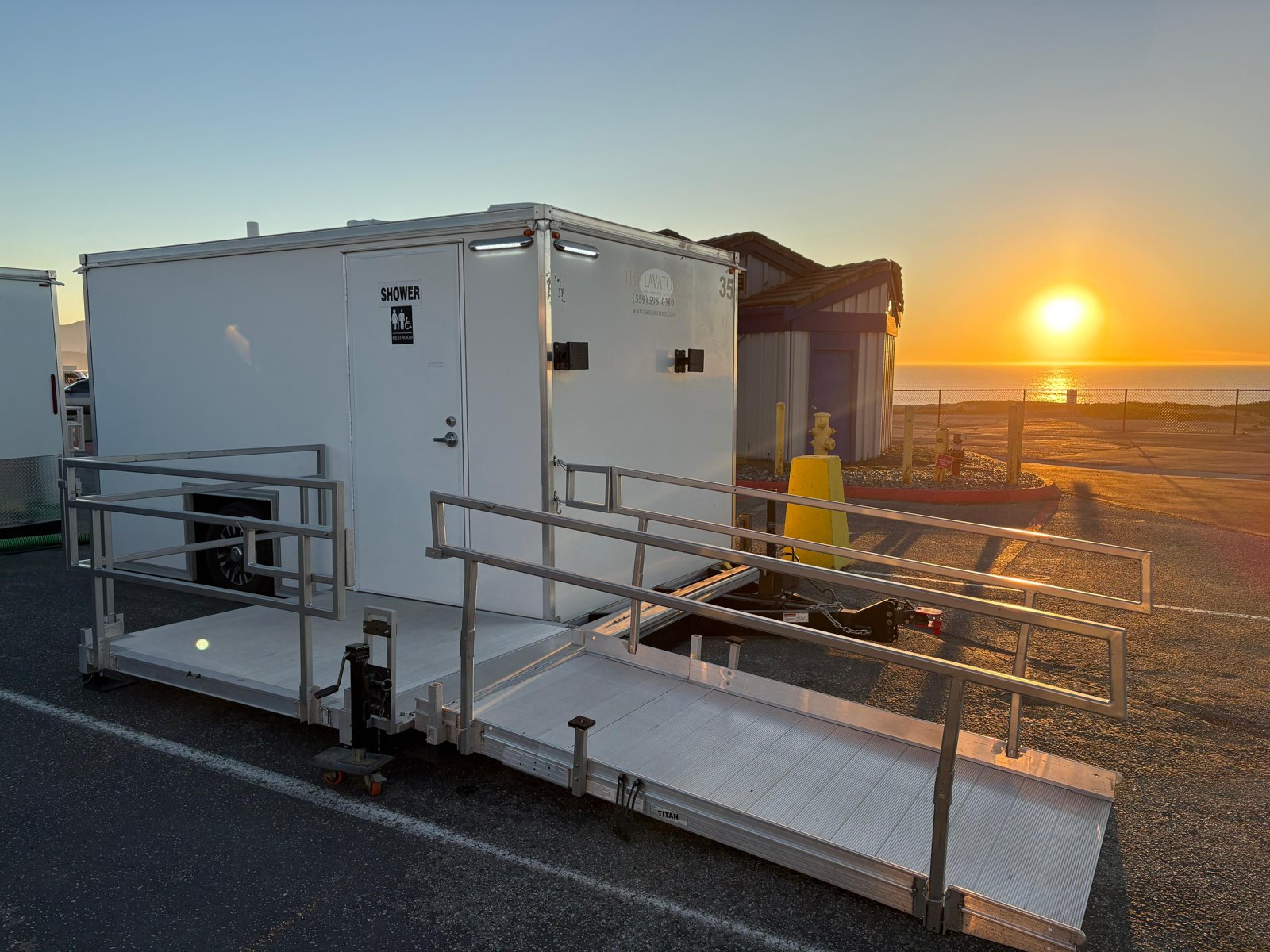
ADA accessible shower options are available and should be part of the plan from the start, not added after somebody asks. Accessibility is not only the unit, it is the route to the unit. A ramp that ends in soft dirt or gravel is not an accessible route. We plan the approach surface along with the placement.
Tell us the real schedule
The best event placements we have done all started the same way. The organizer told us the real headcount, the real overnight population, the actual shower window, the ground conditions, and what time load in and load out happen. From there the plan almost writes itself. Whether the event is in a Salt Lake City park, a field outside Logan, a camp above Park City, a desert site near Moab, or a production base in Cedar City, the specifics are what make it work.
The Utah Site Preparation and Planning Guide
Ground, access, water, power, waste and elevation. The walkthrough we run before any shower trailer delivery in Utah.
Almost every problem we have seen on a shower trailer rental traces back to a site decision made before the unit arrived. Not equipment failure. Site conditions. Soft ground, an approach that a truck could not make, power that was not what somebody said it was, or a drain plan that existed only in theory. This is the walkthrough we run with customers anywhere in Utah, from a downtown Salt Lake City staging lot to a lease road outside Vernal.
Ground: the part people underestimate
A shower trailer full of water is heavy, and it gets heavier as the waste tank fills. The surface has to hold that weight for the entire rental, not just on delivery day. Gravel, compacted road base, pavement and hard packed dirt are all fine. What causes trouble is anything that changes with water.
Irrigated grass is the classic Utah problem. A lawn that looks solid on a Tuesday is soup on Thursday after the sprinklers ran, and now there is a loaded trailer sitting in it. If the unit has to go on turf, we want the irrigation shut off for the placement area a couple of days ahead, and we want ground protection under the tires and jacks.
Clay is the other one. Much of the state has soils that turn slick and greasy when wet, especially in the Basin, in Carbon and Emery counties, and out in the west desert. Dry clay is like concrete. Wet clay will not hold a jack pad and will not let a truck climb back out. If the forecast has weather in it and the site is clay, we plan the approach and the pad accordingly.
Level matters too. Drains only work with gravity, so a unit sitting significantly off level will not drain the way it should and will not feel right to use. We level every placement, but we can only level so much. A site with a serious cross slope needs to be cut or we need a different spot.
Access and turning room
Before anything else, walk the route the delivery truck will take, not the route you would take in a pickup. The questions are simple.
- How wide is the narrowest point, including gates, and is anything overhead going to be in the way? Trees, wires, awnings and low branches stop deliveries constantly.
- Are there turns tight enough to require backing a long way? Backing is doable, but it is much easier if we know first.
- Will the same route still work in the weather the site will actually have? A dirt approach that works dry may not work after a storm, and a route that works in October may be drifted shut in January.
- Is there room for the service truck on the service side, on the schedule, for the whole rental?
In cities like Salt Lake City, Ogden and Provo the access problem is usually parking and permits rather than terrain. Street placements may need a permit and a reserved area, and that takes lead time. In canyon and mountain sites, including a lot of Park City and Wasatch back country placements, the issue is grade and switchbacks. In the rural parts of the state, it is road surface and distance.
Water: hookup versus self contained
There are two ways to run a shower trailer, and picking the right one early shapes everything else.
With a water hookup, the unit connects to a potable source and runs continuously without needing refills. This is the simpler arrangement when a good source exists. What we need is a potable spigot or connection within reasonable hose distance, adequate flow and pressure, and the ability to leave the hose connected safely. In winter that hose has to be protected or heated, which is why a hookup is not automatically the better choice in cold months.
Self contained, the unit runs off onboard fresh water and holds its waste onboard, with scheduled delivery and pumping. This is how most remote Utah placements run, and it works well as long as the service schedule matches the actual usage. The tradeoff is that capacity is finite, so heavy use means more frequent service visits. For long term remote placements we set the schedule conservatively at first and then tune it after we see real numbers from the first week.
Power: shore power versus generator
Shower trailers need real power. Water heating, pumps, lighting, ventilation, climate control and, in winter, freeze protection all draw from the same supply. Two options again.
Shore power means a dedicated circuit of the right size and type at the placement, with a safe path for the cord. The important word is dedicated. Sharing a circuit with a job trailer, a concession stand or a lighting rig is how units end up unexpectedly cold. We confirm the actual receptacle type and capacity in advance rather than relying on a description over the phone, because the difference between what somebody thinks is available and what is really on the wall accounts for a lot of failed first days.
Generator power is standard for remote work. The considerations are sizing, fuel service, noise and placement. A generator has to be sized for peak draw, not average, and in winter the peak includes heat. Fuel service has to be scheduled, because a generator that runs dry on a cold night takes the freeze protection with it. Noise placement matters at events and near occupied areas. And the generator needs its own safe, level spot with air around it.
Waste handling
Gray water from showers and sinks has to be captured and disposed of properly. That means either an approved sewer connection at the site or onboard holding with scheduled pumping and disposal at a permitted facility. Neither one is complicated, but both need to be decided before delivery rather than after.
If a sewer or approved drain connection exists, we need to know where, what the connection looks like, and whether the run can be made with continuous fall. Long flat drain runs cause problems year round and cause freezing problems in winter. If there is no connection, the unit holds its own waste and we build a pumping schedule around expected use.
Elevation and weather
Utah covers a wide range of elevations and climates, and a plan that ignores that will fail somewhere. High elevation sites run colder at night in every season, which means climate control and freeze protection matter even in summer at eight thousand feet. Southern Utah heat means higher water use and a real need for interior cooling. The valleys along the Wasatch Front get extended cold stretches during inversion season, and canyon sites get wind that pulls heat off equipment fast.
Seasonal access is part of this too. Roads that are easy in September may be closed or drifted in February. Spring runoff turns some approaches soft for weeks. We would rather know the site elevation and the month than guess from the city name, because a site above Park City and a site in St. George in the same week are two different jobs.
The walkthrough checklist
Here is what we want to confirm before a delivery date is locked in.
- Exact placement spot, with surface type and slope.
- Delivery route, including narrowest point, overhead clearance and turnaround.
- Whether the surface and route will survive the weather expected during the rental.
- Water source, or confirmation that the unit runs self contained with delivery.
- Power source and type, or generator plan with fuel service.
- Waste plan, connection or pumping schedule.
- Expected headcount and the daily peak window.
- ADA needs and the accessible route surface, not just the unit.
- Site access hours, gate codes, orientation requirements and a real contact who answers the phone.
- Service access on the schedule, and a clear path for removal on the last day.
None of that takes long to gather, and it is the difference between a placement that runs quietly for months and one that generates a phone call every week. Whether the site is in Salt Lake City, Provo, Ogden, Logan, Price, Vernal, Moab, Park City, Cedar City or St. George, the same ten questions apply. Answer them honestly and the rest is straightforward.